

Multilingual Learning: Should You Teach Kannada, Hindi, and English Together?
Walk into any Bengaluru home and you’ll likely hear three languages before breakfast is over — Kannada with the grandparents, Hindi on the TV, English at school drop-off. For parents, this often comes with a quiet worry: is this too much for a preschooler’s brain to handle? Will mixing languages confuse my child, or slow down how quickly they learn to speak?
The short answer: children’s brains are built for exactly this. Let’s look at why, and how to do it in a way that helps rather than overwhelms.
Why the “confusion” myth doesn’t hold up
For years, well-meaning advice suggested sticking to one language at home so children wouldn’t get “mixed up.” Research in early childhood development has moved firmly away from this. Between the ages of 2 and 6, children are in what’s often called a sensitive period for language acquisition — their brains are wired to absorb multiple language systems at once, sorting sounds, grammar, and meaning without the conscious effort an adult would need.
What looks like confusion to a worried parent is usually something else entirely: code-switching. A child who says “Amma, iam thirsty aagide” isn’t muddling two languages — they’re demonstrating that they understand both well enough to blend them intentionally, often to express something more precisely than either language alone would let them.
What multilingual learning actually builds
Beyond communication itself, growing up with Kannada, Hindi, and English together tends to strengthen skills that show up well beyond language:
- Cognitive flexibility — switching between language systems exercises the same mental muscle used for switching between tasks, problem-solving approaches, and perspectives
- Listening precision — children learn to pick up on subtle sound differences early, since each language demands close attention to different pronunciations
- Cultural rootedness — Kannada connects a child to their immediate community and grandparents’ generation; Hindi opens doors across India; English supports academic and global opportunities. Together, they let a child move comfortably across all three worlds instead of feeling they must choose one
How to introduce all three without overwhelming your child
The goal isn’t to drill three languages in structured lessons — it’s to let each one show up naturally in a different part of daily life.
Assign languages to contexts, not schedules. Rather than “20 minutes of Hindi, 20 minutes of English,” let language follow situation: Kannada during meals and with grandparents, English during reading time and books, Hindi through rhymes, cartoons, or festival stories. Children learn language by association far more easily than by timetable.
Don’t correct — model instead. If a child mixes languages mid-sentence, resist the urge to correct on the spot. Simply respond in the correct form yourself. Over time, children absorb the pattern without ever feeling like they got something “wrong.”
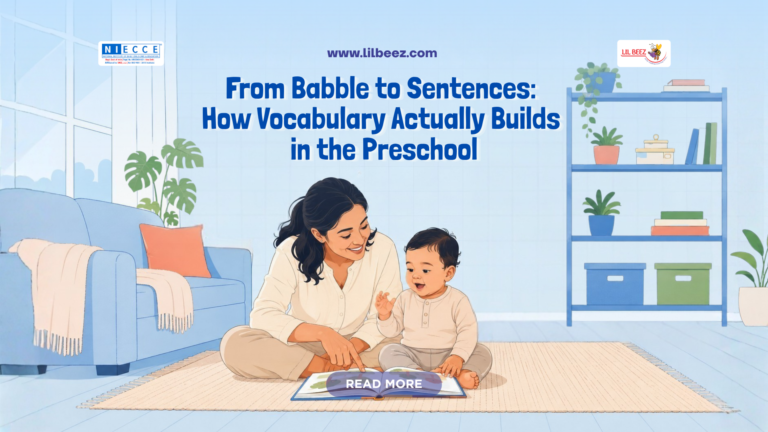
Use picture books as your bridge. Books are one of the easiest ways to introduce a new language without pressure, because the pictures carry meaning even before the words are understood. Reading the same story in two languages on different days is often more effective than trying to explain grammar rules a preschooler isn’t ready for.
Lean on rhymes and songs. Rhythm and repetition make unfamiliar sounds stick. A Kannada folk rhyme or a Hindi counting song does more for pronunciation and vocabulary than direct instruction ever could at this age.
Watch for the natural “dominant language” phase — and don’t panic. It’s common for one language to temporarily take the lead, usually whichever one is used most at school or with peers. This isn’t a sign the other languages are being lost; it typically balances out as exposure continues.
A simple starting point for busy parents
You don’t need a curriculum to begin. Pick one story, one rhyme, and one everyday phrase in each language, and let them repeat naturally through the week — bath time, meal time, bedtime. Consistency in small moments does more than occasional long sessions.
Multilingual learning isn’t a competing set of subjects to balance. Done gently, it becomes one of the richest parts of a Bengaluru childhood — a child who can greet their grandmother in Kannada, sing along to a Hindi film song, and read an English storybook, all in the same afternoon, without ever feeling like any one of them came at the cost of another.