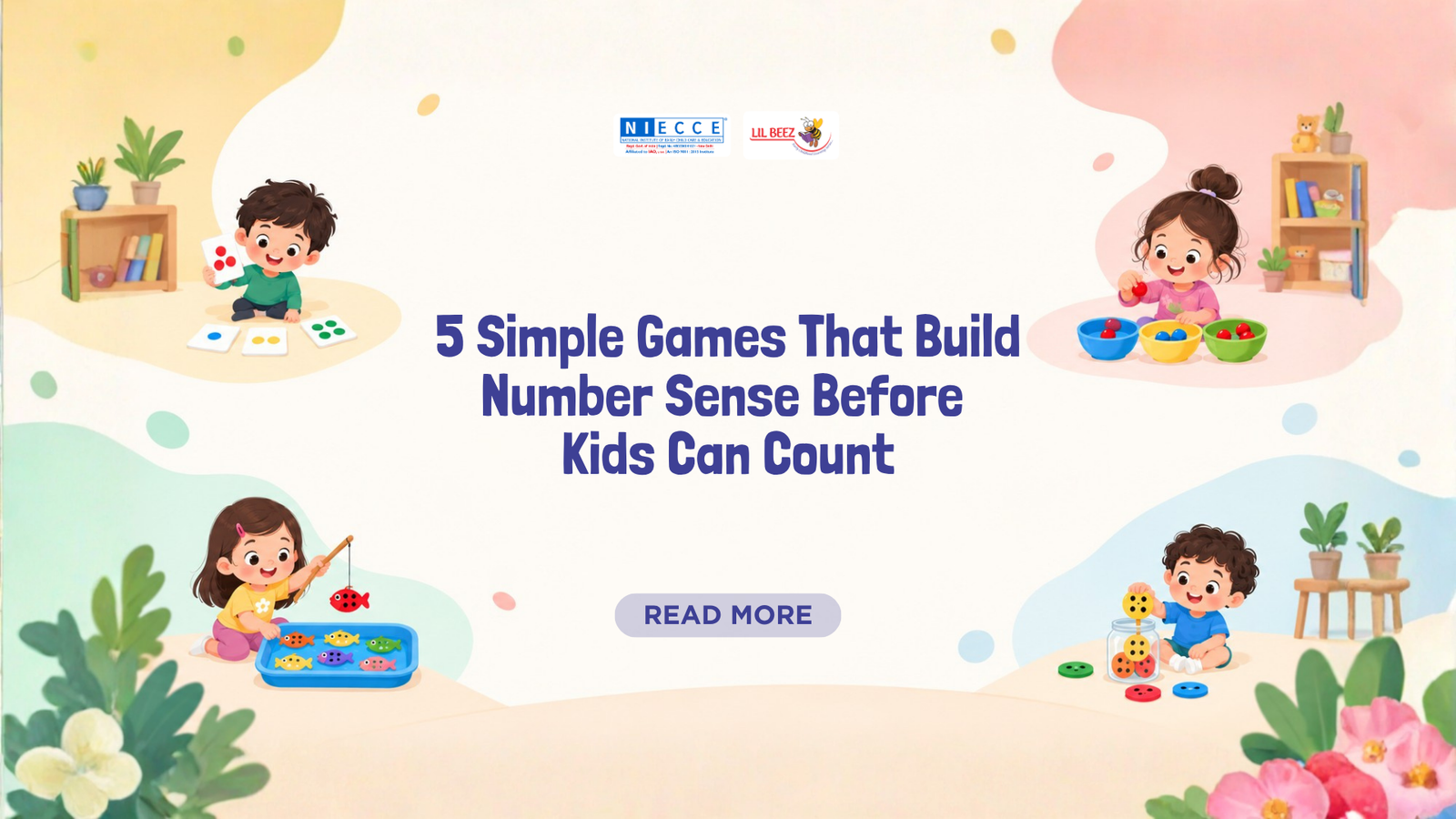

Ask a three-year-old to count to ten, and most will rattle it off proudly. Ask that same child to hand you three blocks instead of five, and you’ll often see them pause. That gap is completely normal – reciting numbers in order and actually understanding what quantity means are two different skills, and the second one, called number sense, has to be built long before formal counting instruction begins.
Number sense is the intuitive understanding of “how many,” “more,” “less,” and “the same as.” It’s the foundation every later maths skill sits on, and the good news for preschool teachers is that it doesn’t need worksheets to develop. It grows through play, repetition, and everyday materials already sitting in the classroom. Here are five simple games that build it without a single number on the page.
1. Sock Matching Baskets
Give children a basket of mismatched socks, buttons, or bottle caps and two smaller baskets. Ask them to sort items into “same” and “different” piles, then move on to grouping by colour or size. This game isn’t about numbers at all on the surface – it’s teaching the skill underneath numbers: recognising which things belong together, which is exactly what counting later depends on.
2. The “More or Less” Plate Game
Place a small handful of objects – pom-poms, pebbles, toy animals – on two paper plates, with clearly different quantities. Ask the child to point to the plate with more, then the plate with less. Swap the objects and quantities each round. This simple comparison game builds the concept of relative quantity well before a child can label exact numbers, and it takes under two minutes to set up.
3. Musical Groups
Play music and have children move freely around the room. When the music stops, call out a number – “form groups of three!” – and children scramble to form small clusters of that size. Anyone left over sits out one round. This game sneaks in real counting practice inside movement and social play, so it never feels like a maths lesson.
4. The Empty Box Guessing Game
Fill a small box with a handful of objects, close the lid, and let one child shake it gently. Ask, “do you think there are a little or a lot inside?” before revealing the count. This builds estimation, an underrated number-sense skill that even adults rely on daily, and it introduces the idea that quantities can be predicted before they’re confirmed.
5. One-to-One Snack Time Counting
At snack time, give each child a small plate and a bowl of crackers or fruit pieces. Ask them to place one cracker on each plate as they go around the table, pointing and saying a number as each one is placed. This is one-to-one correspondence – matching one object to one number word – which is the single most important skill a child needs before counting means anything beyond memorised recitation.
Why These Games Matter More Than Flashcards
None of these activities look like traditional maths instruction, and that’s exactly the point. Children build number sense the same way they build vocabulary – through repeated, low-pressure exposure inside play they already enjoy. A child who has spent months sorting, comparing, and estimating will find formal counting far easier to grasp than one who jumps straight to numbers without that foundation.
For preschool teachers working through NEP-aligned pre-math milestones, these games are worth weaving into daily routines rather than treating as a separate “math time.” A few minutes during snack, transition, or free play is often enough.
At LilBeez, our Nursery and LKG activity kits are built around exactly this progression – introducing quantity, comparison, and one-to-one correspondence through structured play before formal number writing begins. If you’re looking to strengthen pre-math foundations across your classroom in a consistent, NEP-aligned way, explore our learning kits or reach out to our team to see how LilBeez supports early numeracy development.